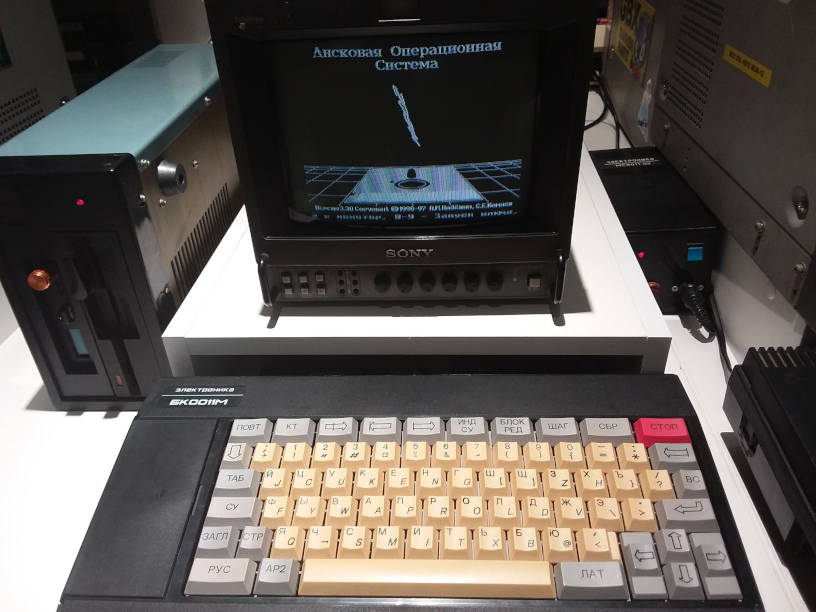
An exhibit from the Yandex Museum, manufactured in November 1990; loading the AnDOS operating system
By 1990, the BK0010 computer had already been in production for about five years. At the time, it was rapidly gaining popularity as a home computer and was widely used in schools. One might have expected this to provide a strong incentive for developing a more advanced, compatible model. Such a model was indeed released that year, but something went wrong, and the sophisticated BK0011M ended up remaining in the shadow of its far less advanced predecessor.
There is some rather dubious information suggesting that the first BK0010 units – which, at the time, came in metal casings – were sold to employees of the Exiton factory as early as 1983. However, the BK did not reach regular retail stores until early 1985. From 1986 onward, they began to see widespread use in schools. In the spring of 1987, I encountered a BK for the first time myself; I was able to play a Snake-type game and do a bit of programming in BASIC. Years later, in 1994, I was somewhat surprised to come across a BK again at the Elektronika store on Leninsky Prospekt in Moscow – it was still the very same 0010 model. I had seen BKs in that store before, and those, too, were always the 0010 model. By 1994, a computer with 32 KB of RAM, sitting in the country’s flagship electronics store, looked completely absurd. In schools, the models used were almost – if not exclusively – the 0010 and 0011.
Back in the 2000s, the question first arose: what ever happened to the BK0011M – or, as it was sometimes called, the Elektronika MS 0513? I still haven’t found a definitive answer, but I have managed to uncover a few things. Although the very fact how the second designation emerged remains a mystery.
By 1989, the 0011 model was ready. As I understand it, this model was produced exclusively for schools as part of a KUVT (a standardized set of educational computing equipment). For some reason, the 0011 was made partially incompatible with the 0010 – specifically, the way it handled sound was altered. Consequently, in 1990, the 0011 underwent an upgrade at the Exiton factory, resulting in the 0011M model. The sound functionality was restored, the updated version of BASIC was replaced with the older variant used in the 0010, and – for reasons that remain unclear – some minor changes were also made to how certain system registers were utilized.
The 0011M model served as the foundation for the development of several excellent software programs. It is clear that both existing and prospective users of the BK series were presented with ambitious plans centered specifically around this model. Yet, for some reason, the 0011M never reached the general retail market – though there are reports that it occasionally appeared in certain shops, possibly those with ties to the Exiton factory. It seems that distribution took place primarily through informal markets, where, in many cases, what was being sold were not finished units, but rather bare circuit boards or "shells" that still required a separate casing. Personally, however, I never encountered anything of the sort at the Moscow electronics markets in the early 1990s. To this day, there is no official information regarding its price – though it is believed to have been somewhere just over 1,000 rubles. For some reason, the production of new BK models was established exclusively at the Exiton plant, while other factories – and even Exiton itself – simply continued to churn out the older model.
At one point, it was even suggested that a BK0011M in a standard factory-produced case was something nearly impossible to find. Later, however, I did manage to get my hands on one. Yet, questions remain. It is still unclear what the original case colors were; online, one can find photos showing both light-beige and black cases. But where does such variety come from? Are they modern reproductions? Since the 2000s, individual enthusiasts have organized small-scale commercial production of the BK0011M, incorporating a few minor improvements. Personally, I have only ever encountered the 0011M in a black case.
How many 0011M units were produced? How many were converted from the 0011 model? How many were sent to schools? Were they ever in schools at all? How many "newly manufactured" units (reproductions) were made? To this day, there are no even remotely precise answers to these questions. Based on indirect evidence, the total number of 0011M units that ended up in private hands is almost certainly less than 5,000 – and, in all likelihood, no more than 2,000. Some units bear serial numbers higher than 10,000; it is possible that the 0011 and 0011M models shared a common numbering sequence. The frequency with which 0011 and 0011M units appear on the secondary market suggests that the former were produced in significantly greater numbers than the latter – even when including the later reproductions. Over 30,000 units of the 0011 model were produced, though the vast majority were utilized of through KUVT. But why were there so few 0011M units? And why was their production handled in such a semi-clandestine manner?
Now, regarding the technical details in comparison to the 0010 model: the RAM capacity was increased fourfold, reaching 128 KB. The processor clock speed was boosted from 3 MHz to 4 MHz, resulting in a performance gain of approximately 10–20%. It became possible to switch palettes – notably including the addition of the color white. It has also become possible to use double buffering when displaying images. Support for timer interrupts was introduced, which, among other things, enabled proper handling of music. A reliable mechanism was implemented to disable the archaic STOP key. A standard floppy disk drive controller was introduced, and the ROM capacity was increased by 8 KB. The system monitor and the set of system functions were updated; consequently, loading programs designed for the 0010 onto a "bare" 0011M is generally impossible – to run them on the 0011M, one must first load a 0010 emulator. Incidentally, software that actually made use of this new set of system functions – known as BOS – never really materialized, save for a few rare, isolated exceptions.
In terms of hardware, the BK0011M offers qualitatively new capabilities compared to the 0010 – nearly everything has seen a noticeable improvement. Some questions arise, however, regarding the contents of the ROM. Perhaps it was a mistake to make BOS incompatible with the previous version? Couldn't the new features have been added to the existing set of functions? Among the new capabilities – aside from support for hardware enhancements – is an 80-column text mode, achieved by reducing the character matrix size. The built-in monitor for machine-language programming was also improved, though its capabilities still fell significantly short of those found on the Apple II or the Commodore+4/128.
The situation with BASIC is even more dismal. On a machine with 128 KB of RAM, only less than 16 KB is available for BASIC; due to the nature of the hard-coded implementation, this is effectively equivalent to just 8 KB on other home computers of the era! The 0011 model featured a more advanced version of BASIC, which left the user with twice as much available memory and included several useful new statements. The 0011M, however, took a step backward. It seems that development of this BASIC was abandoned by 1988, as the new version contained several unresolved, troublesome bugs. Furthermore, the new version switched from double-precision to single-precision arithmetic—though it is difficult to gauge the actual impact of this, given that there are no widely known, standard libraries of BASIC programs for the BK series. Moreover, disk-based versions of this BASIC (for the BK and other platforms) also utilize single-precision arithmetic. Incidentally, many modern reproductions of the hardware were produced without a BASIC ROM altogether. Actually, the Vilnius BASIC is poorly suited for practical programming; it functions more like an emulator for a programmable calculator equipped with a graphical display. It lacks any support for disk operations – yet, despite this, it occupies a full 24 KB of ROM space! For comparison, more powerful BASIC implementations – such as those found on the Corvette, MSX2, or Commodore+4 – fit into just 16 KB.
It is also worth noting that no official provisions were made for the BK0011M to support the FOCAL language, which had been quite widely used on the BK0010.
When comparing the 0011M to foreign-made computers, its overall capabilities place it on par with machines from the mid-1980s, such as the Commodore 128 or the Amstrad CPC6128 – suggesting a lag of about five years. However, since the production and sale of these Amstrad and Commodore models – as well as even more primitive systems – continued successfully until 1990, it would be inaccurate to label the BK as obsolete for that era. The BK’s processor, in particular, deserves special mention: in terms of performance per megahertz – based on its core instruction set – it was on par with the best processors from DEC, including the J11!
The 0011M could run basic proprietary operating systems designed for DEC PDP-11 minicomputers. However, only the RT-11 OS – renamed BK-11 – was actually ported, and for some reason, it saw almost no use. The main problem with this OS is that, due to hardware constraints, no more than 48 KB of memory can be allocated to application programs – a limit that rises to 56 KB on hardware from DEC. Consequently, some proprietary software does not run on the BK. There was also a successful attempt to port Unix, but this served more as a demonstration than a practical implementation of such a robust operating system for actual, everyday use.
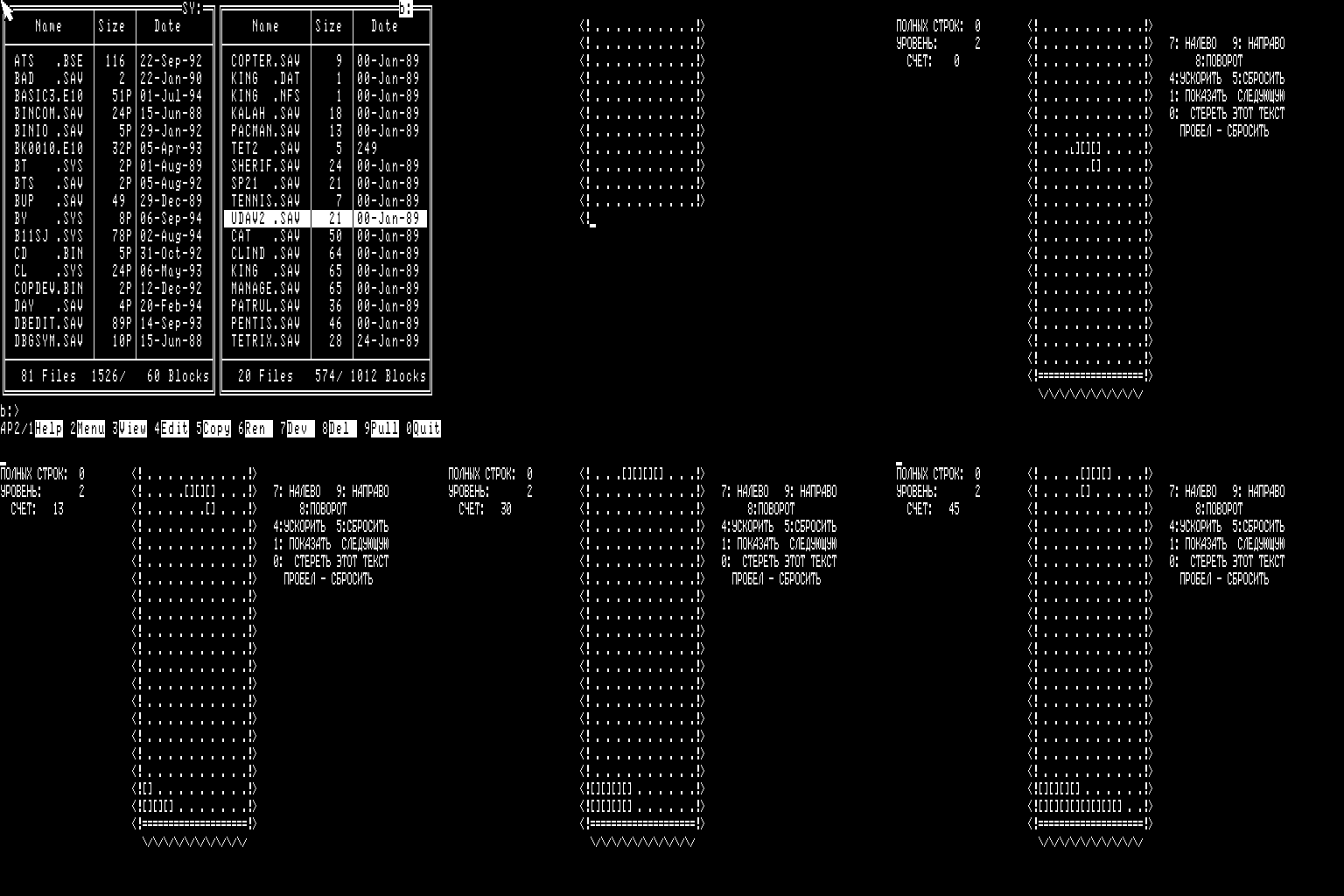
A unique operating system, CSI-DOS, was also created for the 0011M. However, due to its tiny fan base, there is almost no software available for this OS. In contrast, there is much better support for operating systems designed for the entire BK series – such as AnDOS and MkDOS – which are capable of utilizing some of the 0011M’s additional features. In particular, both FOCAL and BASIC were ported to these OS. However, disk support was implemented in an ultra-minimalistic fashion.
Due to a limited fan base, there are relatively few programs specifically designed for the 0011M, though there are some excellent games and demos – some of which have appeared quite recently. I suspect that the emergence of high-quality emulators since the early 2000s has breathed new life into software development for the 0011M. There are about a dozen emulators for the BK0011M; the most sophisticated one is the emulator created by GID, which was recently used as the basis for an online version.
Of particular interest are the cross-development tools for the BK. These include BASIC compilers, the well-known Macro-11 macro assembler, and even one of the major industrial-grade compilers of our time – GNU GCC!
I am not aware of any internet resources dedicated specifically to the BK0011M. However, the overall level of activity among BK fans is second only to that of ZX Spectrum fans, and a significant portion of this activity is centered on the 0011M.
There are also likely no expansion boards designed specifically for the 0011M; most additional hardware appears to be compatible with all models. Of particular note is the relatively recent AZ BK development, which provides the BK with a fundamentally new level of capabilities and for which several impressive programs have already been created.
In conclusion, let’s try to figure out what exactly derailed the successful progression of the 0011M. One of the primary factors may have been the peculiar maneuvering surrounding the UKNC computer – an affair that even drew in academician Ershov. He effectively disparaged the well-functioning BK-based computer class labs (part of the KUVT-86 system) in favor of the UKNC, which were, at the time, unfinished and non-functional. By pushing through the state acceptance of the UKNC, he paved the way for the suppression of BK and Corvette production – this at a time when schools were still facing a severe shortage of computers, a situation that persisted well into the 2000s! This trend was further reinforced by the adoption of new standards for school computers – tailored specifically for the UKNC – which even systems like the MSX2 could not meet! And this, mind you, while in the United States – the most heavily computerized nation in the world – simple Apple computers remained in widespread use in schools until the end of the 1990s! In reality, the UKNC only began to function properly in schools toward the middle of the 1990s, following subsequent upgrades. A vast number of these units were simply written off or stored in warehouses. It’s still a murky story. Faint echoes of those old maneuverings can still be detected even today. Of course, there were other factors, too – such as the decidedly reckless design of the never-released successor, the BK0100. It is possible that some individuals were running their own private ventures centered around the BK0011M. And back then, a lot of things were changing. As is always the case, though. Plus, there’s the rather dubious inclusion of the number 13 in its alternative designation...
Why was there no interest in the development of the BK among those who promoted the introduction of computers into schools – specifically, the aforementioned Ershov and academician Velikhov? It seems the BK team consisted solely of talented engineers, while it lacked the programmers, lobbyists, and popularizers needed to round out the group.
That seems to be all I could write about BK0011M. There are people who know this computer much better than me. Therefore, I will be glad to receive additions, clarifications and comments. Thanks for reading.